
India’s stock market performance has become the centre of an online debate after social-media posts compared recent Indian equity returns with stronger gains reported in markets such as Japan, Brazil and Pakistan.
The comparisons have also triggered criticism of the Union government and Finance Minister Nirmala Sitharaman. However, market performance depends on several factors—including the period selected, benchmark used, currency movements, foreign capital flows, crude-oil prices and global interest rates—so headline percentage comparisons do not necessarily provide a like-for-like picture.
Recent market weakness is nevertheless visible. On September 24, the Nifty 50 fell 1.64% to 23,063.10, while the Sensex dropped 1.67% to 73,580.54, with analysts citing higher global bond yields, rising crude-oil prices, foreign investor selling and concerns surrounding proposed insurance-sector regulations.
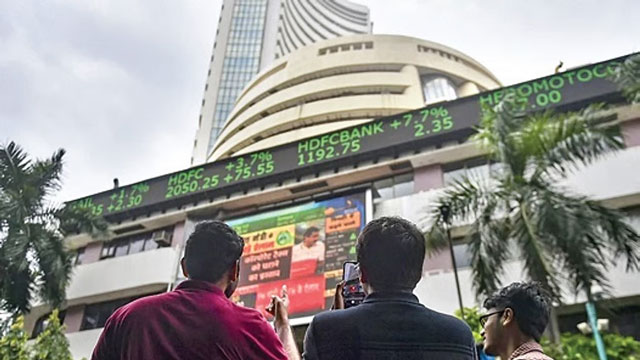
Why Indian Markets Are Being Compared With Global Peers
Posts circulating online have highlighted a two-year performance gap between Indian equities and several overseas markets. Some of the widely shared comparisons claimed gains of roughly 70% for Pakistan, 85% for Japan and 65% for Brazil over selected periods.
Those figures have been used by critics to question India’s recent market performance and aspects of economic policy.
Such comparisons, however, need context. Stock-market returns can vary significantly depending on:
- the exact starting and ending dates;
- whether a broad-market or large-cap index is being used;
- whether returns are measured in local currency or a common currency such as the US dollar;
- dividends and total-return calculations;
- sector composition of different indices;
- inflation, exchange rates and commodity exposure.
As a result, comparing only headline percentages across countries may oversimplify what has happened in each market.
Criticism of Finance Minister Nirmala Sitharaman Trends Online
The weaker relative performance has also generated political criticism of Finance Minister Nirmala Sitharaman, with some social-media users blaming taxation and economic policies for subdued investor sentiment.
Memes and informal references such as “Nimmo Tai” have appeared alongside claims that government policy has hurt the market.
These statements represent political and investor commentary rather than an established causal conclusion. Equity markets respond to domestic policies, but they are also affected by global interest rates, energy prices, geopolitical risks, corporate earnings and foreign capital flows.
Recent reporting, for example, attributes September’s market weakness partly to rising US Treasury yields, higher crude prices and continued foreign portfolio investor selling.
Supporters Point to Longer-Term Nifty Performance
Defenders of the government’s economic record argue that a two-year comparison provides an incomplete picture.
The Nifty 50 has recorded substantial gains over longer periods, including from levels seen around 2019. This illustrates how the conclusion can change considerably depending on the starting point selected.
Long-term market performance also reflects several structural factors, including earnings growth, increased domestic investment through mutual funds and systematic investment plans, and growth in retail participation.
Recent data continue to show strong domestic participation. According to the Association of Mutual Funds in India data cited by Financial Express, SIP contributions reached a record ₹32,297 crore in August 2026, highlighting continued household investment despite weaker short-term equity returns.
Recent Selling Pressure Has Increased
Indian equities have faced a more difficult environment in recent weeks.
On September 24, all major sectoral indices finished lower. The India VIX, which measures expected market volatility, surged nearly 23%, while broader mid-cap and small-cap indices also declined.
Among the factors cited by market analysts were:
- rising US government bond yields;
- renewed strength in crude-oil prices;
- inflation concerns;
- weakness in the Indian rupee;
- foreign portfolio investor selling;
- geopolitical uncertainty;
- concerns surrounding proposed regulatory changes in the insurance sector.
Foreign portfolio investors sold shares worth about ₹5,027 crore on September 24, while domestic institutional investors bought roughly ₹4,301 crore, according to provisional exchange data reported by Financial Express.
Trading Activity Has Also Softened
The debate comes amid reports of reduced activity in parts of the Indian equity market.
Regulatory changes affecting derivatives trading have already influenced volumes. Reuters reported earlier in September that options trading volumes on the National Stock Exchange had fallen by more than 12% year-on-year in August, while tighter regulations were affecting the exchange’s derivatives business.
Lower trading activity can reflect caution among investors and traders, although volumes alone do not indicate where markets will move next.
Oil Prices Remain an Important Risk for India
Crude oil is particularly important for the Indian economy because India imports a large share of its energy requirements.
A sustained increase in global oil prices can affect inflation, the current account, corporate costs and the rupee.
That relationship was evident during September’s trading. When Brent crude eased toward $100 a barrel earlier in the week, Indian equities temporarily recovered. When crude prices rebounded, selling pressure returned.
Foreign Investors Versus Domestic Investors
Another major feature of India’s current market cycle is the divergence between foreign and domestic institutional flows.
Foreign investors have periodically reduced their exposure amid global risk concerns and higher international bond yields. At the same time, domestic institutions and mutual-fund investors have continued buying.
This growing domestic investor base can reduce India’s dependence on foreign capital, although it cannot completely insulate markets from global shocks.
Are Two-Year International Market Comparisons Reliable?
They can be useful, but only when constructed consistently.
For example, Japan’s equity market structure is different from India’s. Brazil has greater exposure to commodities. Pakistan’s market is much smaller and operates under different economic and currency conditions.
A market rising 60% in its domestic currency does not automatically mean an international investor earned the same return after exchange-rate movements.
This is why professional comparisons frequently examine both local-currency returns and dollar-adjusted returns.
What Investors Are Watching Next
Indian markets are likely to remain sensitive to developments in several areas:
Crude oil: Higher energy prices can raise India’s import bill and inflation risks.
US bond yields: Higher global yields can make emerging-market equities relatively less attractive.
Foreign institutional flows: Sustained FPI selling can increase pressure on large-cap stocks.
Corporate earnings: Earnings growth will be important in determining whether current valuations are justified.
Domestic liquidity: SIPs and institutional investment remain a significant support for Indian equities.
Geopolitical developments: Global conflicts and trade disruptions can quickly affect oil, currencies and investor risk appetite.
Bigger Picture
The current debate demonstrates how market performance can become part of a broader economic and political discussion.
Indian equities have underperformed some global markets over selected recent periods, while also delivering substantial gains over longer horizons.
Attributing the difference to a single government policy, minister or economic decision would therefore overlook the combination of domestic and international factors affecting markets.
Investors comparing India with overseas markets should examine consistent time periods, comparable indices, currency-adjusted returns, valuations and corporate earnings rather than relying solely on viral percentage comparisons.
FAQs
Why are Indian markets being compared with Pakistan, Japan and Brazil?
Social-media posts have highlighted stronger equity-market returns in some countries over selected two-year periods, prompting discussion about India’s relative performance. Such comparisons depend heavily on the indices, currencies and dates used.
Why has the Nifty been under pressure recently?
Recent weakness has been associated with higher crude-oil prices, rising US bond yields, foreign institutional selling, geopolitical uncertainty and concerns affecting financial-sector stocks.
Are Indian investors withdrawing from the market?
Not necessarily. Domestic mutual-fund participation remains strong. SIP contributions reached a record ₹32,297 crore in August 2026, according to AMFI data cited by Financial Express.
Does a higher foreign index return mean it performed better for Indian investors?
Not always. Currency movements, dividends, index composition and the exact investment period can materially change comparative returns.
What could influence the Indian stock market next?
Oil prices, US interest rates, foreign investor flows, corporate earnings, domestic institutional buying and geopolitical developments are among the major factors being watched.